
Translating AI news and trends into real implications for talent development leaders.
A very insightful 2-minute read!
Our job is to keep our finger on the pulse of what’s happening with Talent in the Age of AISM.
Here are some little “hits” of what I’ve been reading lately. To read even more and access FREE resources, see TalentintheAgeofAI.com.

Wendy Wiseman
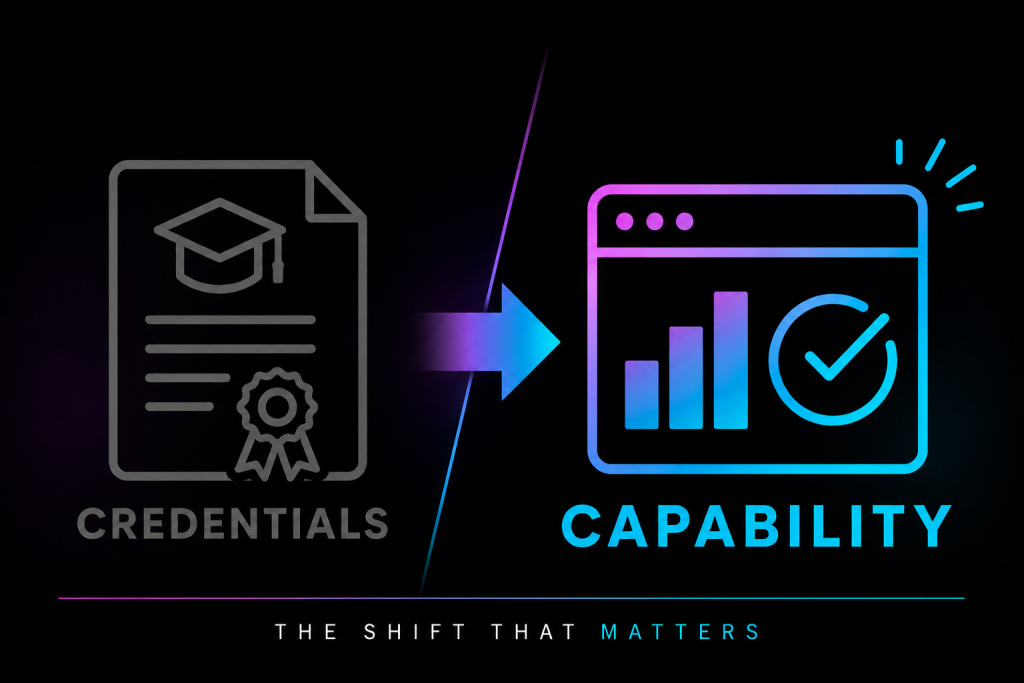
For decades, credentials served as a shortcut for trust.
Degrees, certifications and prestigious employers helped organizations make reasonable assumptions about capability before work was actually seen. In a world where evaluating output was expensive, those signals mattered.
AI is eroding that shortcut.
It is not eliminating credentials, but it is reducing their predictive power.
Why is this happening?
It is now easier than ever to produce convincing artifacts of competence. Well-written documents, structured analyses, polished presentations and even technical outputs can be assisted with AI support.
This changes how work is judged.
When output becomes easier to fabricate or enhance, the signal shifts from what you claim to what you can repeatedly demonstrate.
Proof becomes more important than pedigree.
Proof is different from credentials. It is contextual, iterative and observable in real time. It shows up in how you solve problems, not just where you studied or worked.
Organizations are already responding.
Hiring managers increasingly want live work samples. Leaders care more about how someone performs in ambiguity than what’s written on a résumé. Teams value people who can improve quickly inside the environment.
This will accelerate.
For individuals, this is a structural change in career strategy. Your professional identity is no longer anchored primarily to static achievements. It is anchored to visible capability.
That means:
– Building things, not just describing them
– Showing work, not just listing roles
– Demonstrating learning speed, not just knowledge depth
– Producing outcomes in real contexts, not curated narratives
AI accelerates this shift.
It reduces the friction of producing polished artifacts. When polish becomes cheap, substance becomes more valuable.
The danger is confusing presentation quality with competence.
Organizations may hire well-packaged candidates who underperform. Individuals may optimize for appearance instead of capability.
The counterbalance is repetition. Real proof accumulates over time across contexts and constraints.
So what?
Credentials are not disappearing.
But they are no longer enough.
Proof of capability is becoming the dominant signal of talent.
And, if you want to tell me what you think of this “So What,” email me at Wiseman@TalentintheAgeofAI.com.
Join Talent in the Age of AI today • Follow us on LinkedIn