
Translating AI news and trends into real implications for talent development leaders.
A very insightful 2-minute read!
Our job is to keep our finger on the pulse of what’s happening with Talent in the Age of AISM.
Here are some little “hits” of what I’ve been reading lately. To read even more and access FREE resources, see TalentintheAgeofAI.com.

Wendy Wiseman
When productivity stalls, many organizations reach for another tool.
New chatbot. New assistant. New workflow app. New platform promising transformation.
But most teams are not suffering from a tool shortage.
They are suffering from habit failure.
This is especially true with AI.
Many companies now have multiple AI products available, yet adoption remains shallow and results inconsistent. Why? Because tools do not fix weak operating habits.
AI Often Amplifies Existing Behavior
A team with poor meeting discipline will use AI to create more chaotic meetings.
A team with unclear ownership will use AI to generate more confusion faster.
A team that avoids hard decisions will use AI to produce endless options instead of choosing.
Technology often amplifies behavior already in place.
That is why the highest-performing teams usually look different. They don’t start with tools. They start with norms.
Clear goals.
Fast decision rights.
Documented processes.
Useful feedback loops.
High trust.
Accountability.
Once those habits exist, AI becomes leverage.
Without them, AI becomes noise.
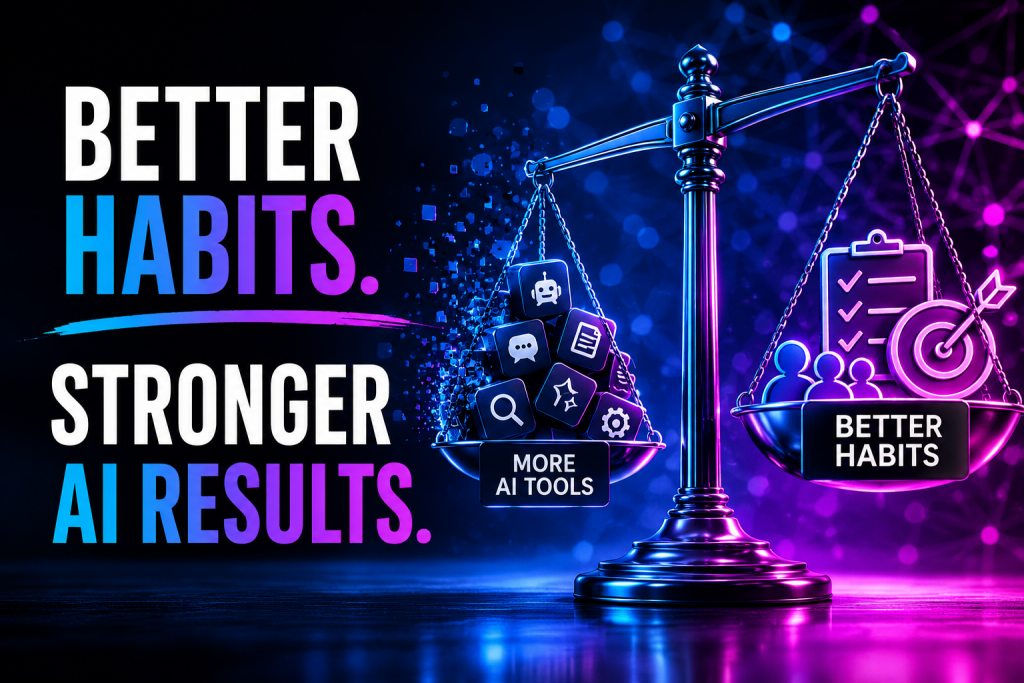
Same Technology. Different Operating System.
Consider a simple example.
One team uses AI to summarize meetings nobody needed, generate action items nobody owns and produce plans nobody follows.
Another uses AI to prepare concise agendas, clarify decisions, assign owners and track progress.
Same technology. Different operating system.
Better Habits Create Better Returns
Leaders should hear the warning: buying tools can feel like progress because it is visible. Fixing habits is harder because it requires management.
But habits are where returns live.
Before approving another AI budget line, ask:
- Do we know where time is actually wasted?
- Are decisions slow because of process or software?
- Do people know who owns what?
- Are we measuring output or outcomes?
- Have we standardized high-value use cases?
Those questions often matter more than vendor demos.
AI is powerful, but it is not magic. It cannot substitute for clarity, discipline or leadership.
So what?
Your next productivity gain may not come from a better model.
It may come from better meetings, cleaner workflows and sharper accountability.
Tools matter.
Habits matter more.
And, if you want to tell me what you think of this “So What,” email me at Wiseman@TalentintheAgeofAI.com.
Join Talent in the Age of AI today • Follow us on LinkedIn