
Translating AI news and trends into real implications for talent development leaders.
A very insightful 2-minute read!
Our job is to keep our finger on the pulse of what’s happening with Talent in the Age of AISM.
Here are some little “hits” of what I’ve been reading lately. To read even more and access FREE resources, see TalentintheAgeofAI.com.

Wendy Wiseman
The Old Hiring Signals Are Breaking Down
For years, hiring systems leaned heavily on proxies: pedigree, past titles, recognizable companies and linear career paths.
Those signals were imperfect, but they were convenient. They helped organizations reduce uncertainty when work outputs were harder to observe and compare.
AI is weakening those signals.
Why? Because output quality is becoming easier to simulate. A polished résumé, a structured case study, a well-written assessment, even a strong portfolio draft can now be assisted, refined or partially generated.
That does not make candidates dishonest. It makes evaluation harder.
What Replaces Credentials: Demonstrated Potential
As surface signals lose clarity, hiring shifts toward something more fundamental: demonstrated potential.
Potential is not hype. It is the ability to learn, adapt and improve in real environments under real constraints. It shows up less in what someone has done and more in how they approach new problems.
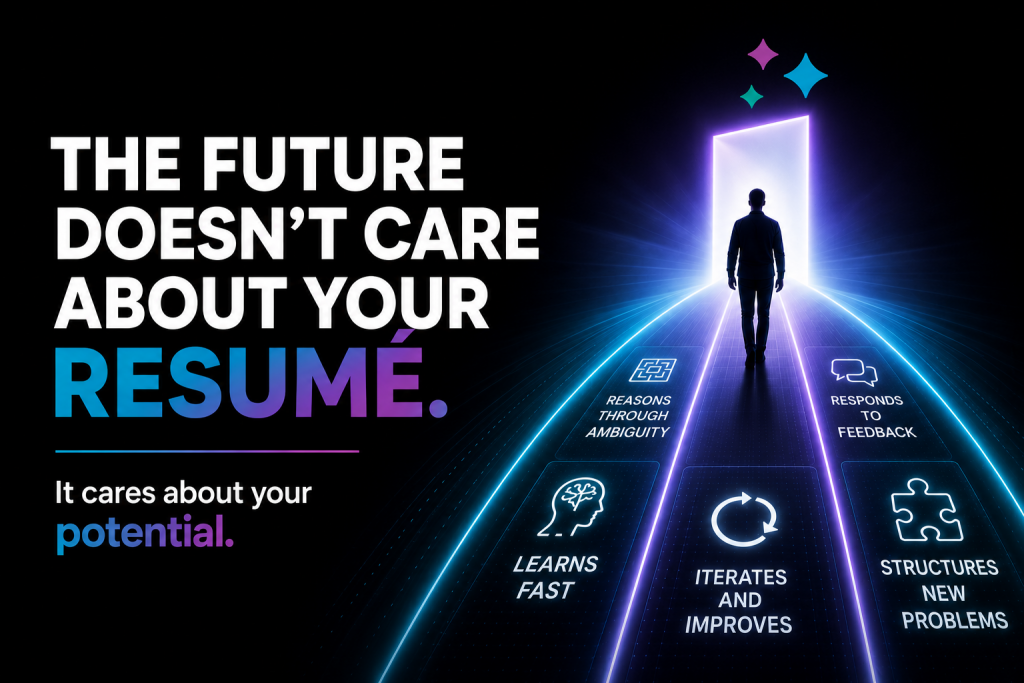
How Smart Organizations Will Evaluate Talent
This changes what good hiring looks like.
Instead of over-indexing on static achievements, strong organizations will increasingly test:
– How quickly someone learns unfamiliar domains
– How they reason through ambiguity
– How they respond to feedback
– How they structure problems they’ve never seen before
– How they improve output over iterations
In other words, hiring becomes less about credentials and more about trajectory.
Why AI Is Accelerating This Shift
AI accelerates this shift because it levels the playing field of initial output. If everyone can produce competent first drafts, the differentiator becomes who can refine those drafts into excellent outcomes.
That is a skill signal, not a resume signal.
The Risk of Holding onto Old Hiring Models
The risk for companies is inertia. Many will continue hiring based on familiar patterns long after those patterns stop predicting performance reliably. That creates expensive misalignment: strong-looking candidates who underperform in dynamic environments and overlooked candidates who would have excelled with the right conditions.
What This Means for Candidates
For candidates, this is equally important.
You are no longer competing only on what you have done. You are competing on how clearly you can show how you think. The ability to learn in public, iterate, and improve is becoming a hiring advantage in itself.
The organizations that recognize this early will build stronger teams faster. Those that don’t will keep optimizing for signals that no longer correlate with success.
So what?
Hiring is shifting from validation of the past to prediction of the future.
Potential is no longer a soft concept.
It is becoming the most reliable signal left.
And, if you want to tell me what you think of this “So What,” email me at Wiseman@TalentintheAgeofAI.com.
Join Talent in the Age of AI today • Follow us on LinkedIn