
Translating AI news and trends into real implications for talent development leaders.
A very insightful 2-minute read!
Our job is to keep our finger on the pulse of what’s happening with Talent in the Age of AISM.
Here are some little “hits” of what I’ve been reading lately. To read even more and access FREE resources, see TalentintheAgeofAI.com.

Wendy Wiseman
Management Is Being Redefined
For a long time, the core function of many managers was coordination. They moved information between teams, tracked progress, managed status updates, and ensured work stayed aligned with plans.
That role worked in slower systems where information flow was limited and execution required heavy human coordination.
AI Is Collapsing Much of that Coordination Layer
Updates are automated. Dashboards refresh in real time. Summaries are generated instantly. Task tracking is embedded in tools rather than maintained through meetings.
As administrative work declines, a more demanding expectation rises: managers must now create disproportionate improvement in people and outcomes.
In other words, they must become talent multipliers.
What a Talent Multiplier Actually Does
A multiplier manager does not just oversee work. They improve the quality of the people doing the work. They increase judgment, sharpen thinking, and accelerate capability growth across the team.
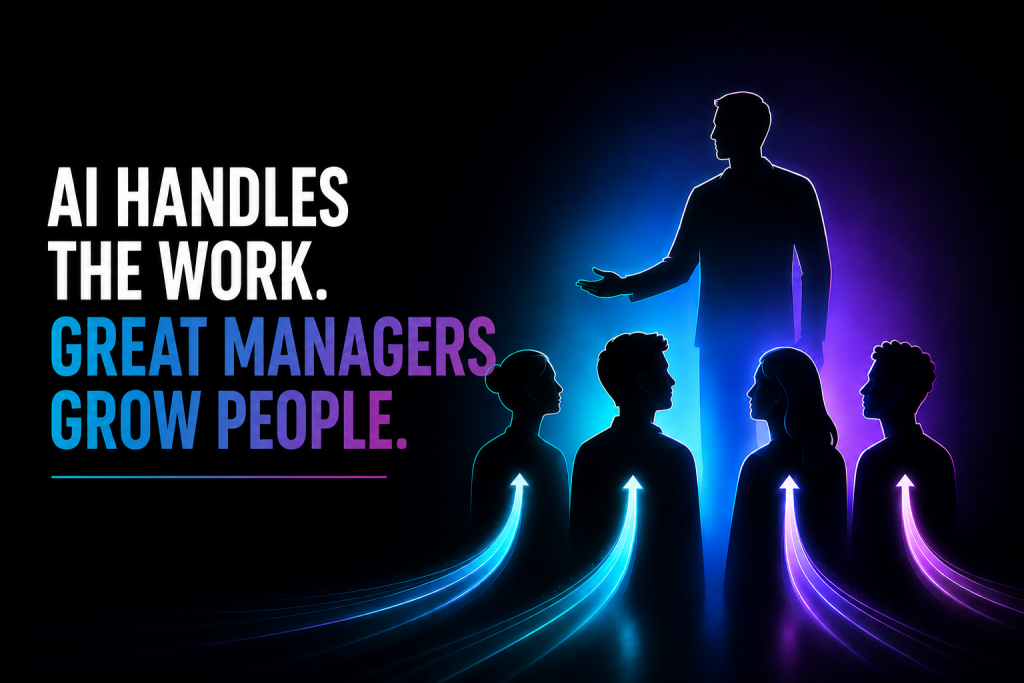
This is fundamentally different from traditional oversight.
It includes:
– Coaching how to think, not just what to do
– Raising the quality of decisions
– Removing ambiguity that slows execution
– Creating clarity in priorities and tradeoffs
– Designing systems that reduce wasted effort
– Giving feedback that improves future performance
Why This Shift Is Happening Now
AI amplifies this shift because execution is no longer the bottleneck it once was. If tasks can be produced faster, then the limiting factor becomes whether teams are working on the right things and executing them well.
Managers who fail to adapt will find themselves increasingly irrelevant to the actual flow of work. Their updates may still exist, but their impact will shrink.
Managers who succeed will look different. They will spend less time reporting and more time developing. Less time tracking and more time improving. Less time organizing and more time elevating.
A New Way to Measure Managers
This also changes how organizations should evaluate management performance. Activity is no longer a proxy for value. The number of meetings run or reports produced says little about team effectiveness.
The real question becomes: are people getting better under this manager?
Are decisions improving? Is execution getting faster and cleaner? Is the team gaining independence or becoming dependent?
That is the new scoreboard.
So what?
AI is not removing management.
It is stripping it down to its real purpose.
Only managers who improve talent will remain valuable.
And, if you want to tell me what you think of this “So What,” email me at Wiseman@TalentintheAgeofAI.com.
Join Talent in the Age of AI today • Follow us on LinkedIn