
Translating AI news and trends into real implications for talent development leaders.
A very insightful 2-minute read!
Our job is to keep our finger on the pulse of what’s happening with Talent in the Age of AISM.
Here are some little “hits” of what I’ve been reading lately. To read even more and access FREE resources, see TalentintheAgeofAI.com.

Wendy Wiseman
For a while, the AI conversation centered on access.
Who has the tools?
Who has licenses?
Who is experimenting?
Who is ahead?
Access Is No Longer the Advantage
That made sense early on. New technology often creates an advantage for first movers.
But that phase is ending.
Today, access is spreading quickly. Most knowledge workers can reach powerful AI tools in some form. The real divide is no longer access.
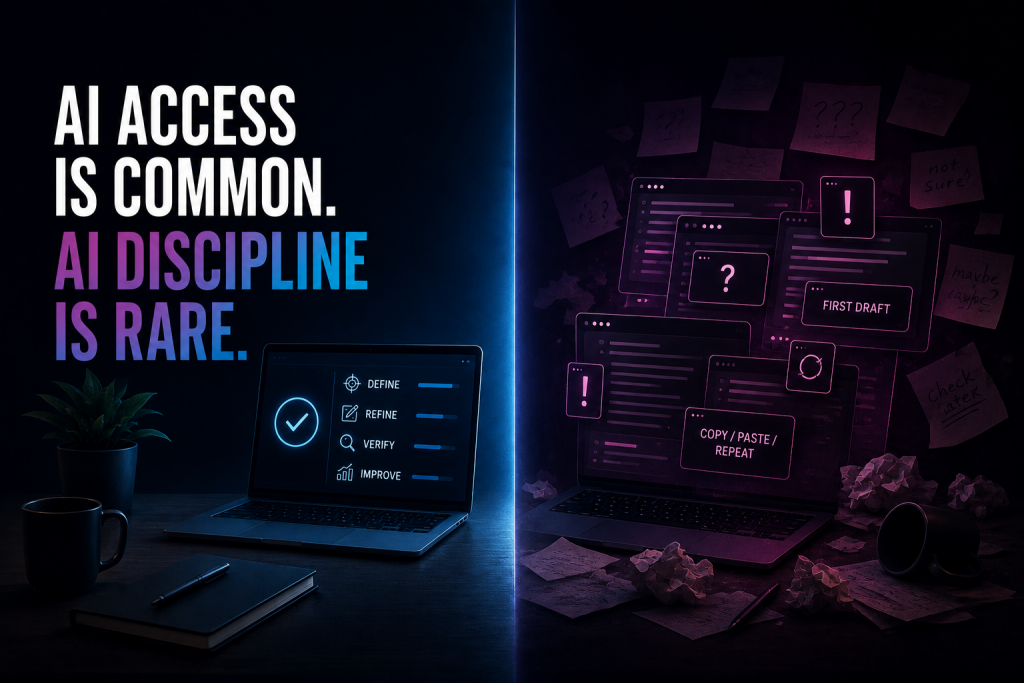
It is discipline.
Some people use AI like a professional athlete uses training equipment: intentionally, repeatedly, with standards.
Others use it like a toy.
That difference matters.
AI Discipline Shapes Outcomes
AI discipline means knowing when to use it, when not to use it and how to pressure-test what it gives back. It means using AI to improve thinking rather than replace it.
Disciplined users ask better questions. They refine prompts. They compare outputs. They verify facts. They edit aggressively. They protect confidential information. They know that speed without scrutiny can become expensive.
Undisciplined users do the opposite.
They paste in vague requests. They accept first drafts. They outsource judgment. They trust confident-sounding nonsense. They mistake activity for progress.
Same tool. Different outcomes.
Discipline Compounds Over Time
This is why some organizations report major gains from AI while others see minimal value. The technology is often similar. The behavior is not.
Discipline also compounds.
A user who improves prompts weekly, builds workflows monthly and sharpens judgment daily becomes dramatically stronger over time. Another user who casually experiments remains stuck at surface level.
That gap will widen.
Leaders should pay attention here. Buying licenses is not the same as building capability. AI adoption without operating standards often produces scattered use, inconsistent quality and rising risk.
The Next Advantage Is Behavioral
The better move is to teach habits:
- Verify important outputs
- Use AI for drafts, not final accountability
- Protect sensitive data
- Measure value created
- Share winning workflows
- Keep humans responsible for decisions
So what?
The next winners won’t necessarily be those with the best tools.
They’ll be those with the best habits.
AI access is common.
AI discipline is rare.
That rarity creates advantage.
And, if you want to tell me what you think of this “So What,” email me at Wiseman@TalentintheAgeofAI.com.
Join Talent in the Age of AI today • Follow us on LinkedIn