
Translating AI news and trends into real implications for talent development leaders.
A very insightful 2-minute read!
Our job is to keep our finger on the pulse of what’s happening with Talent in the Age of AISM.
Here are some little “hits” of what I’ve been reading lately. To read even more and access FREE resources, see TalentintheAgeofAI.com.

Wendy Wiseman
For the last several years, one question has dominated the AI conversation:
Which jobs will AI replace?
It makes a great headline.
I’m increasingly convinced it’s the wrong question.
Jobs aren’t neat little boxes of identical activities. A job is a collection of tasks, decisions, relationships, responsibilities, experiences and—sometimes—moments that matter deeply to another human being.
AI may be able to perform some of those tasks brilliantly.
That doesn’t necessarily mean we should hand it the whole job.
And that distinction may become one of the most important talent decisions organizations make.
We Are Learning What AI Can Do. Now We Need to Decide What It Should Do.
The early AI race was largely about capability.
Can it write this?
Can it analyze that?
Can it handle the customer request?
Can an agent complete the workflow?
Those remain important questions.
But capability isn’t the same thing as wisdom.
Bill Gates recently argued for the idea of “human-reserved” work—roles or activities society deliberately keeps human because human involvement has intrinsic value. His example was compassionate caregiving.
I think businesses need their own version of that conversation.
What interactions should remain human because trust matters?
Where does apprenticeship matter?
Which tasks help junior employees develop judgment?
Where is empathy part of the value being delivered?
Which decisions require somebody to actually own the consequence?
Suddenly this becomes much more interesting than “Can AI do it?”
Efficiency Can Have a Hidden Cost
Imagine an entry-level employee whose first two years once involved research, preparing drafts, sitting in meetings, watching experienced colleagues make decisions and occasionally getting things wrong.
Some of that work is absolutely automatable.
Great.
But those tasks were also how the employee learned.
Remove every low-level task and we may accidentally remove the apprenticeship that produces high-level talent.
That is a talent development problem.
Recent research on early-career work suggests AI is already changing the nature of entry-level jobs, while 40% of early-career workers surveyed by NACE said they had changed or were considering changing their career plans because of AI.
Meanwhile, other 2026 research suggests new employees are being moved away from routine administrative work and toward more analytical responsibilities.
That sounds promising.
But here’s the question:
How do people become good analytical thinkers if we automate away all the work through which they once learned the business?
That’s the next challenge.
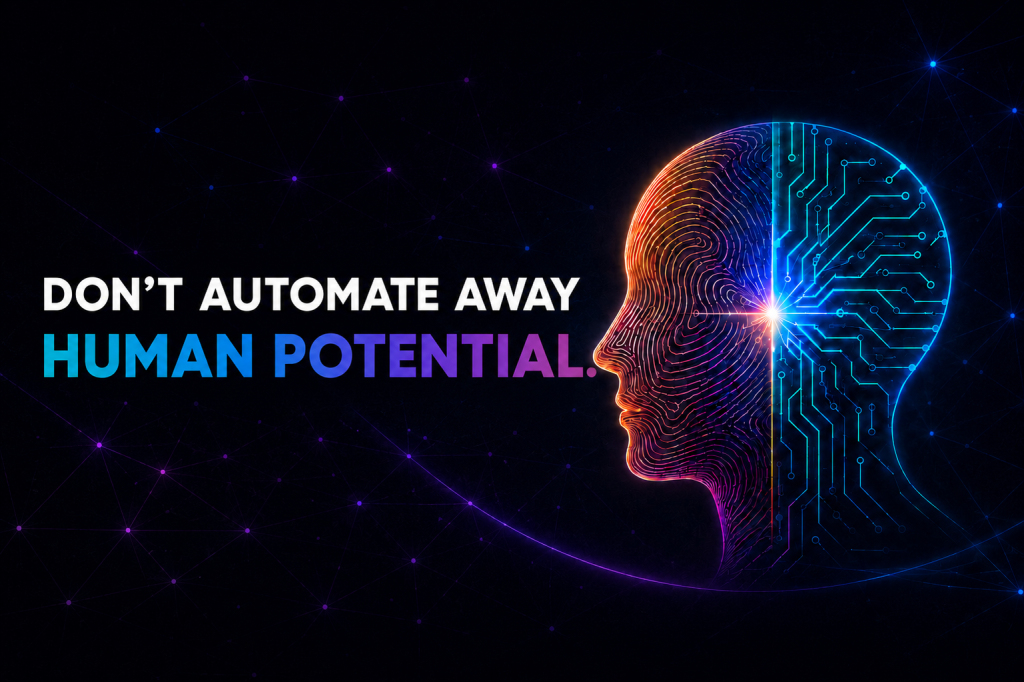
Talent Leaders Need a “Keep Human” Strategy
Organizations are developing AI strategies.
They also need human strategies.
For every workflow being redesigned, I’d ask three questions:
What should AI do?
What should humans do?
And what must humans continue learning to do—even if AI could technically do it for them?
That third question may be the most important.
Because efficiency is not the only organizational objective.
We also need to produce tomorrow’s experts, managers, decision-makers and leaders.
So What?
Stop asking only which jobs AI will eliminate.
Start asking which human capabilities your organization cannot afford to stop developing.
Automate the task if it makes sense.
But don’t accidentally automate away the experience that creates your next generation of talent.
And, if you want to tell me what you think of this “So What,” email me at Wiseman@TalentintheAgeofAI.com.
Join Talent in the Age of AI today • Follow us on LinkedIn