
If you want to understand how AI is actually changing work, it helps to look beyond strategy decks and formal initiatives and pay closer attention to how work is already getting done across your organization.
In many cases, the most meaningful shifts aren’t happening through structured rollouts or training programs. They’re happening in the day-to-day work of your highest performers, who have begun to incorporate AI into how they think, how they approach tasks, and how they manage their time. These changes are often incremental and informal, but over time they start to reshape the work in ways that are difficult to ignore.
It’s Not Happening Evenly
AI adoption tends to spread unevenly, creating a growing divide between those who are still trying to understand where it fits and those who have already started using it in practical ways.
Some employees are beginning to use AI to accelerate drafting, synthesize information more efficiently or test ideas before bringing them into team discussions. Others are still operating within the same workflows they’ve always relied on. As those differences accumulate, the impact goes beyond speed or efficiency and starts to influence how people contribute and the level at which they engage in their work.
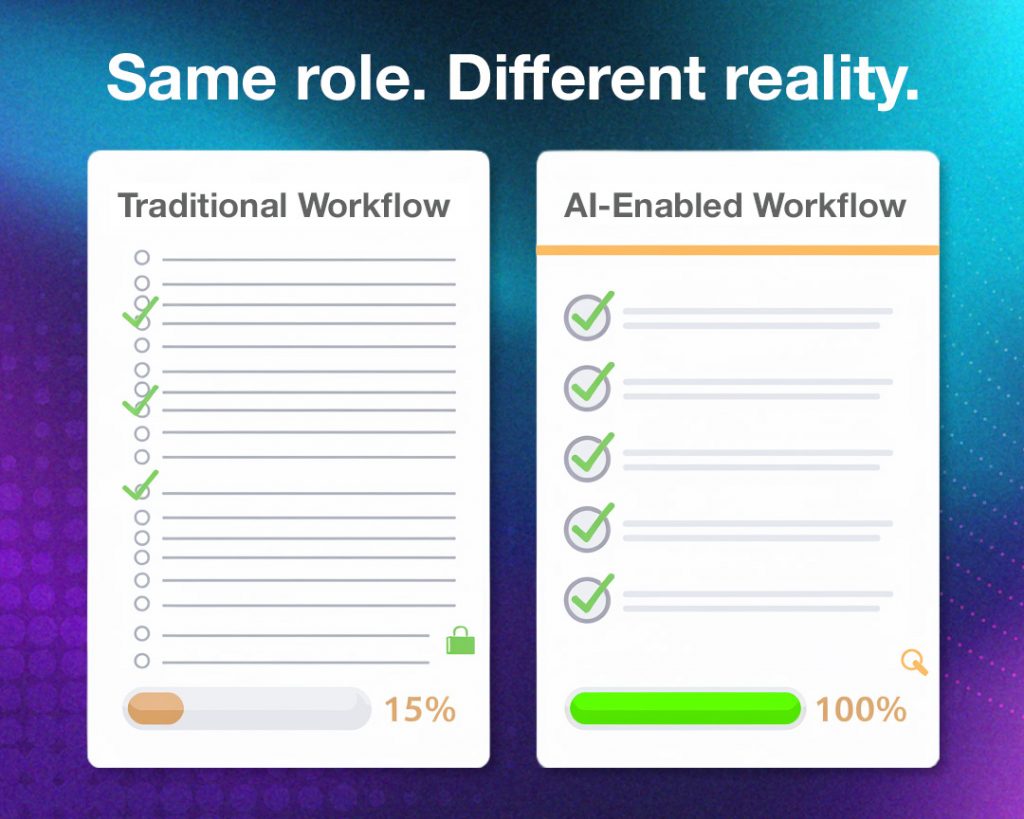
At a certain point, the distinction is no longer about who is using AI and who isn’t. It becomes a question of how differently the same role is being performed across individuals and teams.
The Role Hasn’t Changed. The Work Has.
From a formal perspective, very little may appear different. Job descriptions haven’t been updated, expectations are still framed in familiar terms and performance is often measured against the same criteria that existed before AI became part of the workflow.
In practice, however, the work itself has begun to evolve for some employees. Those who are effectively using AI are often operating with faster feedback loops, producing stronger initial drafts and creating more space for higher-value thinking. Others continue to move through the same processes they’ve always followed.
This creates a growing gap that isn’t always immediately visible but becomes increasingly difficult to explain through effort or experience alone. Over time, it starts to redefine what effective performance looks like, even if the organization hasn’t formally acknowledged that shift.
What Leaders Are Missing
At this stage, the primary risk is not that people aren’t using AI. In many organizations, the larger issue is that some employees are using it in meaningful ways while others are not, and there is limited visibility into how those differences are affecting outcomes.
Without that visibility, high performers can begin to pull further ahead, informal workflows take shape without being shared, and managers continue to evaluate performance based on assumptions that no longer reflect how work is actually being done. Teams may appear aligned on paper while operating quite differently in practice.
Perhaps most importantly, organizations miss the opportunity to learn from what is already working, simply because no one is capturing or translating those practices into something others can build on.
This Isn’t a Training Gap
It can be tempting to respond to this dynamic by expanding training or introducing new tools, but the challenge at this stage is less about awareness and more about understanding.
The more useful questions are not where AI could be introduced, but where it is already making a meaningful difference, what is improving as a result and how those changes are reshaping the way work gets done.
Until those patterns are visible, it becomes difficult to scale adoption in a way that is grounded in real outcomes rather than assumptions.
Where Talent Development Comes In
This is where talent development has an opportunity to shift its focus. The role is no longer limited to introducing new capabilities, but extends to making emerging practices visible and helping organizations understand how work is already changing.
That might involve identifying where high performers are using AI effectively, documenting how those workflows are structured and creating opportunities for others to learn from them. It also requires helping leaders recognize where expectations and performance measures may need to evolve to reflect a different way of working.
When those patterns are surfaced and shared, they provide a foundation for more intentional and consistent adoption.
So What?
The question isn’t whether AI is changing work. That shift is already underway, often in ways that are easy to overlook if the focus remains on formal initiatives alone.
The more important question is whether organizations can recognize where those changes are already taking hold within their own teams.
Because in many cases, your highest performers are not waiting for direction. They are already redesigning how their work gets done, gradually and in ways that may not be immediately visible.
If that work remains hidden, the gap between how work could happen and how it actually happens will continue to widen. But if it can be surfaced, understood and shared, it creates an opportunity to do more than accelerate adoption.
It allows organizations to redefine what effective performance looks like in the age of AI.